
Black Friday: discounts up to 70%See the products on sale →LIMITED QUANTITIES!
•23 MIN READ

Vitamin D3: how many IU a day, when to take it and why with K2 (a winter guide)

How many IU of vitamin D3 a day for adults, children and pregnant women, morning or evening, why with K2 and when a 25(OH)D test makes sense. A winter guide.

Vitamin D3: how many IU a day, when to take it and why with K2 (a winter guide)

Quick answer. From October to March, most adults here do well with 1,000 to 2,000 IU (25 to 50 µg) of vitamin D3 a day, taken with a meal that contains a little fat. The time of day isn’t decisive; what matters is taking it regularly. K2 is a sensible addition when D3 is taken for a longer time and bone health matters to you, but it isn’t required. If you want a stronger dose or know your level is low, there are also 5,000 IU formulas with K2.

Fall arrives and with it the same question: should I start taking vitamin D? Here people search for “vitamin d3 mk,” “d3 vitamin,” “vitamin d mk,” “vitamin D3 how much a day,” “d3 k2.” Behind all of them is the same thing: how much, when and whether with K2. In this guide we answer directly, with numbers and with sources. You’ll read both what the studies showed and what they didn’t, so you don’t pay for promises.

Vitamin D is a little unusual. We don’t get it mainly from food but from our skin, when UVB rays from the sun fall on it. That’s why the same person can have a completely different blood level in July and in January, even though they eat the same food.
01Quick pick

Which vitamin D3 for whom

The one-minute answer. Each situation is explained below.

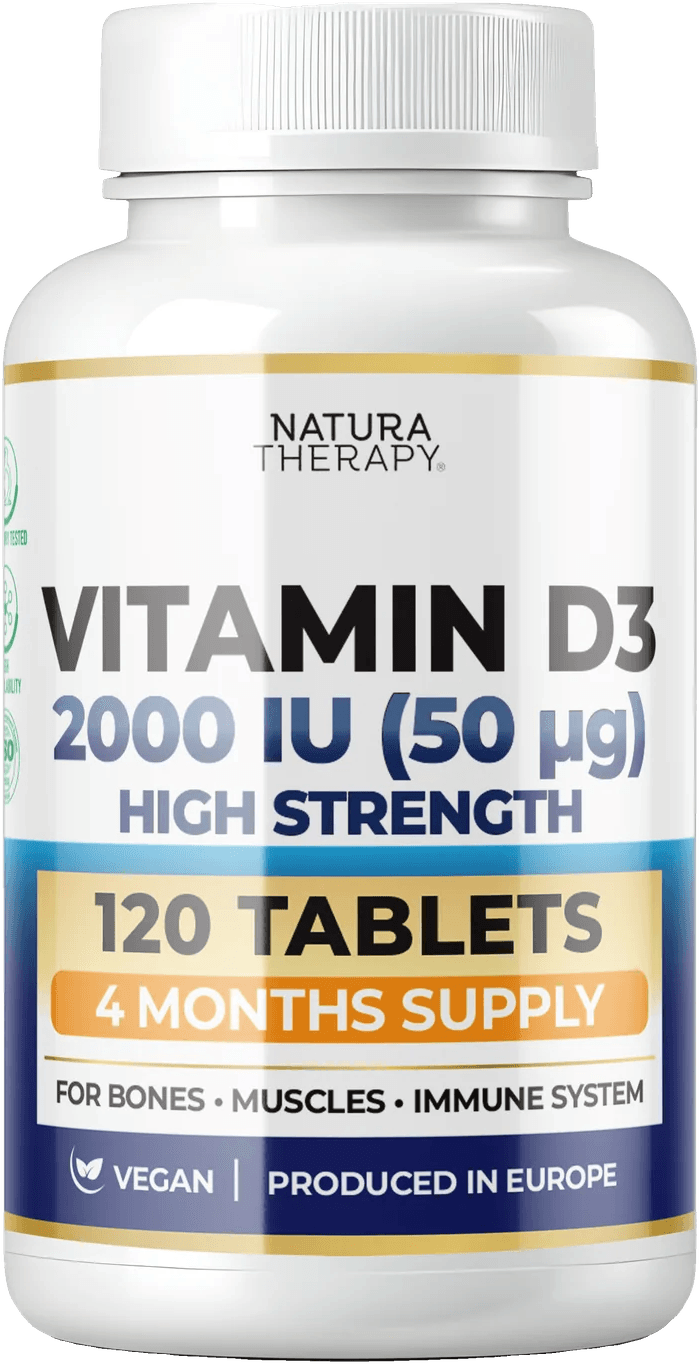
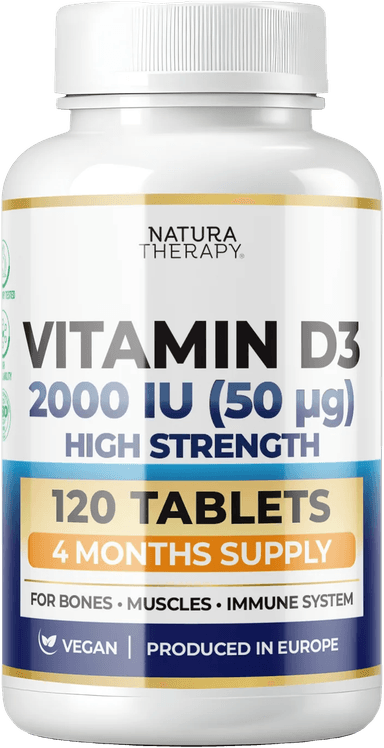
Vitamin D3, 120 tablets
01 · The classic winter routine

Vitamin D3, 2.000 IU

Why
One tablet a day with breakfast, from October to March. A dose in the middle of the recommended range.
Important
The time of day isn’t decisive; regularity is what matters.
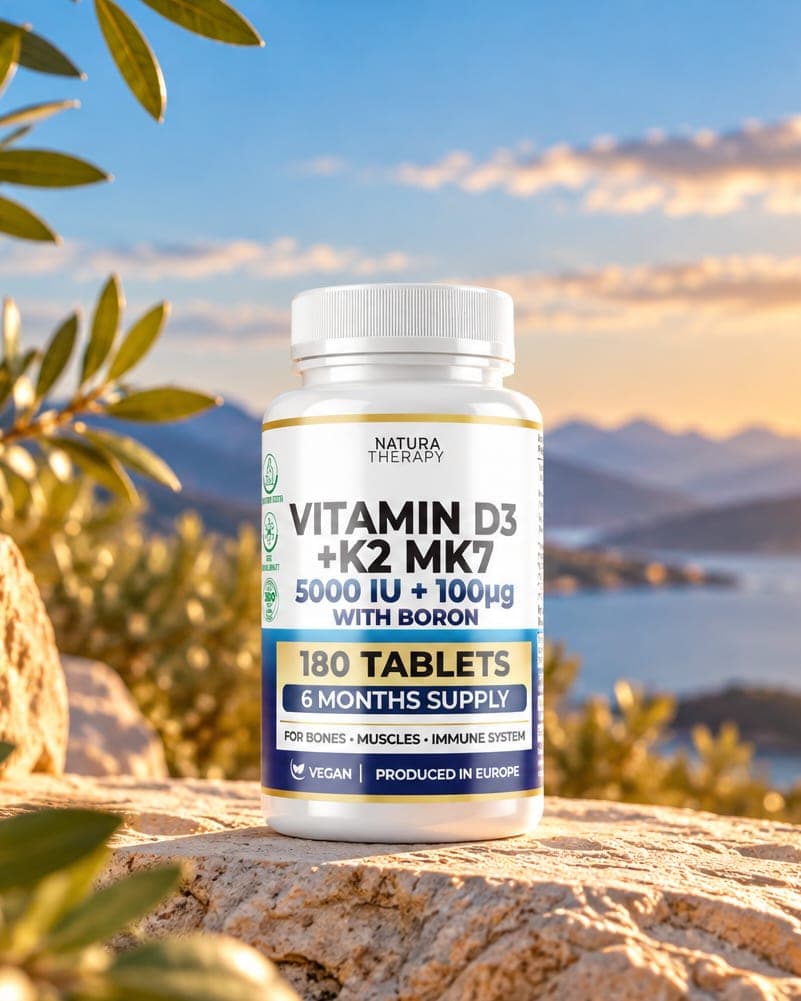
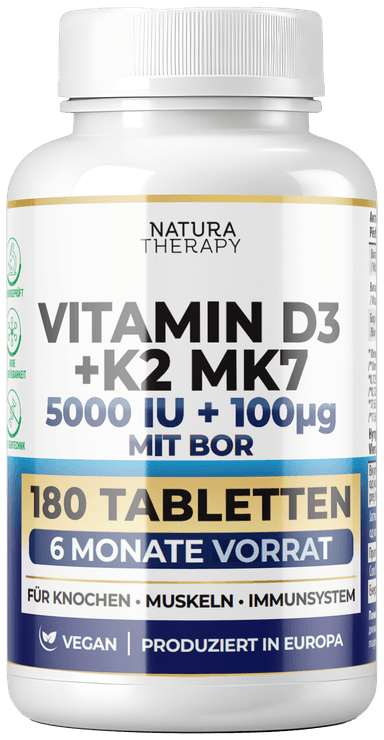
D3 + K2 + Bor, 180 tablets
02 · A stronger dose in winter

D3 + K2 + Bor

Why
5,000 IU D3, 100 µg K2 (MK-7) and boron in one tablet. For a stronger dose, when a test showed a low level or your doctor recommended more.
Important
Don’t take another vitamin D product alongside it.
D3 + K2 + Bor, 180 tablets
03 · D3 all year, bone health matters to you

D3 + K2 + Bor

Why
When D3 is taken for months, combining it with K2 makes sense. Vitamin K contributes to the maintenance of normal bones.
Important
Don’t take another vitamin D product alongside it.
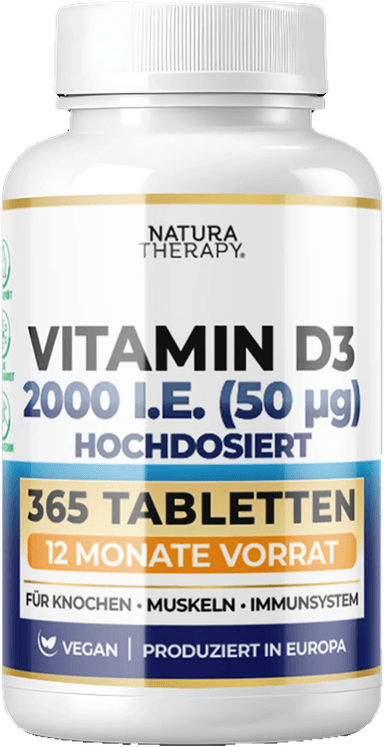
Vitamin D3, 365 tablets
04 · Best value for the whole year

Vitamin D3, 365 tablets

Why
At one tablet a day, it lasts a whole year, with no new order every month.
Important
One pack for the whole year.
05 · You take blood-thinning medicines

Ask your doctor first

Why
Vitamin K can change the effect of warfarin and acenocoumarol. No K2 until you have talked to a doctor.
Important
Don’t start or stop K2 on your own.
Liquid Vitamin C
06 · You already take Liquid Vitamin C

No second D3 tablet

Why
One 15 ml serving already provides 2,000 IU of D3.
Important
Add up all your sources before you add anything.
07 · Children and babies

Drops, with the dose set by a pediatrician

Why
Babies usually get drops of 400 IU a day, and there are special forms for children.
Important
The form and the dose are decided by the pediatrician.
08 · Pregnancy and breastfeeding

The dose is decided by your gynecologist

Why
Many prenatal vitamins already contain vitamin D, so count them too.
Important
K2 in pregnancy only on a doctor’s advice.
02Winter

Why winter is a problem, even in sunny Macedonia

A footpath through an autumn park with fallen yellow leaves and low sun breaking through the trees

We get vitamin D mainly through the skin, when UVB rays fall on it. That’s why the same person can have a completely different level in July and in January, even though they eat the same things.

  • Measurements at our latitude have shown that from November to February the sun’s rays are too slanted for the skin to make a meaningful amount of D3.
  • Vitamin D is stored in fat tissue, but the blood level gradually drops over the course of the winter.
42°north latitudeSkopje: sounds southern, but for vitamin D it’s borderline
80.8%of pregnant women in winterwere deficient in a Macedonian study, although most were taking multivitamins with D
1 in 10 to 1 in 5Europeans in winterbelow 30 nmol/L, which is a clear deficiency

When the skin makes vitamin D at our latitude

JanFebMarAprMayJunJulAugSepOctNovDec
November to February: the rays are too slanted, the skin makes little D3
October and March: transitional, only around noon and with bare arms
summer: if you are often outdoors in the sun, a supplement is usually not needed

Everyday life doesn’t help

At the office until 16h, then in the car, and it’s dark by 17h. When levels are measured, the numbers are low.

Summer doesn’t build up a reserve

The level in the blood falls gradually. It is usually lowest toward the end of February.

That’s why it makes sense in winter

In the cold part of the year, vitamin D is one of the few supplements that really makes sense for most people.
03What it does

What vitamin D does, and what it doesn’t

In the EU, vitamin D has six authorized health claims. Vitamin D contributes to:

Immunity
normal function of the immune system
Bones and teeth
maintenance of normal bones and teeth
Muscles
maintenance of normal muscle function
Calcium and phosphorus
normal absorption and utilization, normal blood calcium levels
Cell division
the process of cell division
In children
normal growth and development of bones

Vitamin D contributes to the normal absorption and utilization of calcium from food.

What the studies show

No effect

Does not prevent cancer or heart disease

According to a large study in healthy adults, 2,000 IU a day for about five years did not lead to fewer cases of cancer, heart attacks or strokes than placebo.
No effect

Without a deficiency, no fewer fractures

Research shows that in people who were not deficient, the supplement did not reduce fractures.
Inconsistent

Colds: evidence that doesn’t agree

Studies on colds have shown small and inconsistent results. Vitamin D has no approved claim for colds. What is approved is that it contributes to the normal function of the immune system.
  • Bottom line: not being deficient is important, but megadoses bring no extra benefit.
  • Important: Vitamin D is not a medicine for COVID, cancer, depression or autoimmune diseases. If a product promises that, it is not true and it is not allowed in the EU.
04Dose

How many IU of vitamin D3 a day

1,000 to 2,000 IUadults, in winter25 to 50 µg; the blood level stays stable
600 IUminimum for an adult15 µg (EFSA), when the skin makes none
4,000 IUupper limit for adults100 µg from all supplements combined (EFSA)
1 µg = 40 IUcalculationfor labels in µg or mcg
  • 25 µg = 1.000 IU
  • 50 µg = 2.000 IU
  • 100 µg = 4.000 IU

Usual daily dose in winter

IU per day, by age
Adults 18 to 641,000 to 2,000 IU
Over 651,000 to 2,000 IU
Pregnant and breastfeeding women600 to 2,000 IU
Children 11 to 17600 to 1,000 IU
Children 1 to 10400 to 600 IU
Babies up to 1 year400 IU, drops
05001.0001.5002.000 IU

Upper limit (EFSA)

in total, from all tablets, drops and multivitamins
Adults 18 to 644,000 IU
Over 654,000 IU
Pregnant and breastfeeding women4,000 IU
Children 11 to 174,000 IU
Children 1 to 102,000 IU
Babies up to 1 year1,000 IU up to 6 months, 1,400 IU up to 1 year
  • If you are overweight, the level usually rises more slowly. That’s not a reason to increase the dose on your own, but to get tested.

Full overview by age

WhichHow much per dayUpper limitNote
Adults 18 to 641,000 to 2,000 IU4.000 IUFrom October to March, or all year if you rarely spend time in the sun
Over 651,000 to 2,000 IU4.000 IUThe skin makes less, so it often makes sense all year
Pregnant and breastfeeding women600 to 2,000 IU4.000 IUAs agreed with your gynecologist; many prenatal multivitamins already contain D
Children 11 to 17600 to 1,000 IU4.000 IUForm and dose as advised by a pediatrician
Children 1 to 10400 to 600 IU2.000 IUDrops or a form for children, as advised by a pediatrician
Babies up to 1 year400 IU, drops1,000 IU up to 6 months, 1,400 IU up to 1 yearThe dose is decided by your pediatrician
05How to take it

When and how to take vitamin D3

Salmon fillet, boiled eggs, fresh mushrooms and a bowl of yogurt on a light stone kitchen table, natural daylight
1

With a meal that contains some fat

Vitamin D is fat-soluble. Eggs, cheese, olive oil, yogurt, avocado or nuts. Not on an empty stomach with just a glass of water.
Morning table by a window: a glass of water, coffee and oatmeal with banana and almonds
2

Morning or evening

There is no proven “best” time. Tie it to the meal you always eat, most often breakfast or lunch.
A white tablet on a palm next to a glass of water
3

Every day, without skipping

Vitamin D doesn’t work within a few hours like coffee; it slowly raises the level over the weeks.
4

With magnesium and calcium

Magnesium and vitamin D3 can be taken on the same day: D3 with breakfast, magnesium in the evening. Which magnesium to choose is in the magnesium guide.

If the evening dose disturbs your sleep

The studies on this are weak, but if it happens to you, take it in the morning instead.

Calcium: more is not better

Most people who eat dairy products don’t need extra calcium.

D3, not D2

D3 is the same form the skin makes. According to studies, it raises and maintains the blood level better than D2, which is why our products are D3 too.
  • Tip: Put the pack next to your coffee cup or the salt shaker on the table. With vitamin D, what matters is regularity over months, not one forgotten tablet.
06D3 with K2

Why D3 with K2

An older woman walking down steps in the sun, with a pack of D3 + K2 + Bor in the foreground

The question we get most often. The logic is simple:

D3normal absorption of calciumK2 (MK-7)maintenance of normal bones
  • Approved in the EU: vitamin K contributes to the maintenance of normal bones and to normal blood clotting.
  • MK-7: the form of K2 in supplements stays in the blood longer than K1 from green vegetables, so one dose a day is enough.
  • Not essential: vitamin D “works” without K2 too, but the combination makes sense, especially when D3 is taken for a longer period.
In more detail

D3 + K2 + boron: why they are in one tablet

What K2 (MK-7) does alongside D3, how much we really know about boron, who the combination makes sense for, and how to take it safely all winter.

Read the guide to D3 + K2 + boron

What the studies on K2 show

Modest

Women after menopause

In healthy postmenopausal women, 180 µg of MK-7 a day for three years led to slower loss of bone mass in some of the measurements.
Modest

The reviews of studies

They find small improvements in bone density, with studies of varying quality.
Not proven

“It carries calcium into the bones”

The claim that K2 moves calcium from the blood vessels into the bones has not been proven in humans by reliable clinical studies.

D3 alone is enough when

  • you want a simple winter routine from October to March
  • you eat green leafy vegetables, cheeses and fermented dairy products, which provide vitamin K
  • you already take a multivitamin or calcium with K2
  • you take an anticoagulant medicine (warfarin, acenocoumarol): in that case, no K2 without your doctor

D3 + K2 makes more sense when

  • you take vitamin D all year, for months on end
  • bone health matters to you: women during and after menopause, older people, little physical activity
  • your doctor recommended a higher D3 dose after a blood test
  • you also take calcium as a supplement

If you take blood-thinning medicines

Vitamin K can change the effect of warfarin and acenocoumarol (also known here as Sintrom). Don’t start or stop K2 without telling your doctor.

The newer anticoagulants (rivaroxaban, apixaban, dabigatran) don’t work through vitamin K, but still ask your doctor before any new supplement.

07Food

Foods with vitamin D

Salmon fillet, boiled eggs, fresh mushrooms and a bowl of yogurt on a light stone kitchen table, natural daylight

It’s hard to get enough from food, but it’s worth knowing what helps.

How many IU food provides

versus 1,000 IU a day
Oily fish, a serving of salmonup to 600 IU
a few hundred to 600 IU, depending on whether it is wild or farmed
Yolk, per egg40 to 80 IU
Winter target, every day1,000 IU

Oily fish

Salmon, mackerel, sardines, trout.

Egg yolk

About 40 to 80 IU per egg.

Mushrooms exposed to sun or UV light

They provide D2; the amount varies a lot.

Fortified products

Some types of milk, plant-based drinks and cereals. Check the label.

Cod liver oil

A rich source, but with a lot of vitamin A, so not in large amounts.
  • To get 1,000 IU every day, you would have to eat fish almost every day. That’s why food is a good foundation, and in winter a supplement fills in the rest.
08Test

The 25(OH)D test: when, and what the numbers mean

The test is done from a blood sample, in any laboratory. You don’t need to have it before starting 1,000 to 2,000 IU in winter: the Endocrine Society recommendation says healthy people don’t need to be tested routinely.

Levels in nmol/L

below 30
below 12 ng/mL
Deficiency
Needs a talk with a doctor and a dose to replenish levels
30 to 50
12 to 20 ng/mL
Insufficient
A common finding in winter; a regular daily dose is usually enough
50 to 125
20 to 50 ng/mL
Enough for most people
The target in most recommendations
125 to 250
50 to 100 ng/mL
Higher
No need for more, check the dose
above 375
above 150 ng/mL
Possible toxicity
Only with very high doses over a longer period; see a doctor urgently
ng/mL × 2,5 = nmol/L

The test makes sense if

  • you have bone pain, muscle weakness or frequent fractures
  • you have a bowel, kidney or liver disease, or have had stomach surgery
  • you take medicines that affect vitamin D, for example corticosteroids or some antiepileptics
  • you are pregnant or planning a pregnancy
8 to 12 weeksfollow-up after startingnot after a few days; always go over the result with your doctor
09Winter plan

One winter with vitamin D3

Vitamin D is a habit for the whole winter, not for one day. Here is the realistic picture:

October
Start with one daily dose, with a meal. There is sun only around noon.
The first weeks
The level rises slowly. It’s important not to skip days.
After 8 to 12 weeks
If you get tested, this is the right time for a check.
End of February
Without a supplement the level is usually at its lowest, so regularity pays off most at this time.
March
A transitional month: the sun starts to help again around noon.
A white tablet on a palm next to a glass of water
10Safety

Deficiency, overdose and safety

Signs of deficiency

Mild deficiency usually has no signs at all. When it is longer-lasting and more pronounced, the following may occur:

Bone pain

Especially in the lower back, hips and legs.

Muscle weakness

Difficulty getting up from a chair or climbing stairs.

More frequent falls

In older people.

Rickets in children

Bone deformities and slow growth.

Osteomalacia

In adults, softening of the bones.
  • Tiredness, hair loss and low mood have dozens of possible causes. Don’t self-medicate with high doses; check with a doctor. The only way to know for sure is a 25(OH)D test.

Overdose: how much is too much

It doesn’t happen from the sun or from food, but from tablets: when very high doses, usually tens of thousands of IU a day, are taken for a long time, or when several products are combined without adding up the total amount.

Then the calcium in the blood rises too high. Signs: nausea, vomiting, intense thirst, frequent urination, constipation, confusion and fatigue, and the kidneys can also be affected.

Add up all your sources

example from the guide, IU per day
D3 tablet2,000 IU
Multivitamin800 IU
Liquid Vitamin C2,000 IU
Total4,800 IU
Upper limit for adults4,000 IU

When to see a doctor first about vitamin D

  • kidney stones or kidney disease
  • sarcoidosis or another granulomatous disease
  • hyperparathyroidism
  • thiazide diuretics or heart medicines (digoxin)
  • all doses for children and babies

Children, babies and pregnancy

Babies

Breast milk contains little vitamin D. Pediatricians usually recommend drops of 400 IU a day up to the first birthday, and often longer. For formula-fed babies, the dose is decided by the pediatrician.

Children

Vitamin D contributes to the normal growth and development of bones. A form for children (drops, spray, chewable tablets) and a dose according to age, on a pediatrician’s advice.

Pregnancy and breastfeeding

Deficiency in winter is very common. The dose is decided by the gynecologist, because many prenatal vitamins already contain vitamin D. K2 during pregnancy only on a doctor’s advice.
11Our D3

Our vitamin D3 products: a comparison

Our vitamin D3 comes in tablets, one a day with a meal. You can always see the current price on the product page.

  • Tablets, 1 a day with a meal
  • D3 form
  • Packs of 120 to 365 tablets

How long one pack lasts

days, one tablet a day
D3 + K2 + Bor
180 tablets180 days
Vitamin D3
120 tablets120 days
365 tablets365 days

How much D3 in one dose

D3 + K2 + Bor, 1 tablet5,000 IU + 100 µg K2
Vitamin D3, 1 tablet2,000 IU
Liquid Vitamin C, 15 ml2.000 IU
A D3 + K2 + Bor pack next to a glass of water

Full overview

ProductD3 per doseK2Pack sizeLasts
Vitamin D3, 120 tablets2,000 IU (50 µg)none120 tablets120 days
Vitamin D3, 365 tablets2,000 IU (50 µg)none365 tablets365 days
D3 + K2 + Bor, 180 tablets5.000 IU (125 µg)100 µg MK-7 + 2 mg boron180 tablets180 days

Quick pick

  • Classic winter routine: Vitamin D3, one tablet with breakfast. The 365-tablet pack lasts a whole year.
  • A stronger dose and K2 in one tablet: D3 + K2 + Bor, our strongest formula. For when you need a stronger dose: a test showed a low level or your doctor recommended more.
  • Want vitamin C and zinc too, without a tablet: Liquid Vitamin C provides 2,000 IU D3 in 15 ml.

Two important rules

  • Alongside D3 + K2 + Bor or Vitamin D3, don’t take another product with vitamin D. If you take Liquid Vitamin C, don’t add another D3 tablet on the same day without checking the total amount.
  • If you take blood-thinning medicines, ask your doctor first because of the K2.

Current prices, bundles and delivery terms are always on the product page and in the cart.

12Questions

Frequently asked questions about vitamin D3

How many IU of vitamin D3 a day is enough?+

For most adults in winter, 1,000 to 2,000 IU (25 to 50 µg). EFSA sets the upper limit for adults at 4,000 IU (100 µg) a day from all supplements combined.

When should you take vitamin D3, in the morning or in the evening?+

The timing isn’t decisive; what matters is regularity. It’s most practical with breakfast or lunch, every day at about the same time. If an evening dose disturbs your sleep, take it in the morning.

Should vitamin D3 be taken with food?+

Yes, with a meal that contains some fat, for example eggs, cheese, yogurt or olive oil. That way it is absorbed better than on an empty stomach.

Why D3 with K2?+

Vitamin D contributes to the absorption of calcium, and vitamin K to the maintenance of normal bones. The combination makes sense when D3 is taken for a longer period and your bones matter to you, but the evidence for K2 is modest and it is not essential.

How many µg is 1,000 IU?+

1,000 IU is 25 µg. The conversion is 1 µg = 40 IU, so 2,000 IU is 50 µg and 4,000 IU is 100 µg.

Can you overdose on vitamin D3?+

Yes, but only with tablets, when very high doses are taken for a long time. Then the calcium in the blood rises too high. With doses up to 4,000 IU a day in healthy adults, the risk is very small.

How much vitamin D for children and babies?+

Babies up to 1 year usually get drops of 400 IU a day, and children from 1 to 10 years 400 to 600 IU. The dose and the form are decided by the pediatrician.

Can vitamin D3 be taken during pregnancy?+

Yes, vitamin D is important in pregnancy too, and deficiency in winter is common. The dose is decided by the gynecologist, because many prenatal vitamins already contain vitamin D.

What are the signs of vitamin D deficiency?+

Mild deficiency usually has no signs. A longer-lasting and pronounced deficiency can cause bone pain, muscle weakness and more frequent falls. The only way to know for sure is a 25(OH)D test.

What blood level of vitamin D is normal?+

For most people, 50 to 125 nmol/L (20 to 50 ng/mL) is sufficient. Below 30 nmol/L (12 ng/mL) is a deficiency. Always go over the result with a doctor.

Can vitamin D3 and magnesium be taken together?+

Yes, they can be taken on the same day, with no need to space them apart. Magnesium contributes to the maintenance of normal bones and to normal muscle function.

Should vitamin D3 be taken in summer too?+

If you are often outdoors in the sun, it is usually not needed in summer. If you work indoors, rarely go out or are older, it can be taken all year round, in doses up to the upper limit.

This text is for information only and is not a substitute for advice from a doctor or pharmacist. Food supplements are not medicines and are not a substitute for a varied and balanced diet and a healthy lifestyle. Do not exceed the recommended daily dose. Keep out of reach of children.

Sources 15
  1. EFSA NDA Panel, “Dietary reference values for vitamin D,” EFSA Journal, 2016;14(10):4547 (doi:10.2903/j.efsa.2016.4547)
  2. EFSA NDA Panel, „Scientific opinion on the tolerable upper intake level for vitamin D, including the derivation of a conversion factor for calcidiol monohydrate“, EFSA Journal, 2023;21(8):8145 (doi:10.2903/j.efsa.2023.8145)
  3. Demay M.B. et al., “Vitamin D for the Prevention of Disease: An Endocrine Society Clinical Practice Guideline,” J Clin Endocrinol Metab, 2024;109(8):1907–1947 (PMID 38828931)
  4. Manson J.E. et al., N Engl J Med, 2019;380(1):33–44 (PMID 30415629)
  5. LeBoff M.S. et al., N Engl J Med, 2022;387(4):299–309 (PMID 35939577)
  6. Martineau A.R. et al., BMJ, 2017;356:i6583 (PMID 28202713)
  7. Jolliffe D.A. et al., Lancet Diabetes Endocrinol, 2021;9(5):276–292 (PMID 33798465)
  8. Tripkovic L. et al., Am J Clin Nutr, 2012;95(6):1357–1364 (PMID 22552031)
  9. Webb A.R. et al., J Clin Endocrinol Metab, 1988;67(2):373–378 (PMID 2839537)
  10. Cashman K.D. et al., Am J Clin Nutr, 2016;103(4):1033–1044 (PMID 26864360)
  11. Atanasova B.A. et al., J Med Biochem, 2025;44(6):1183–1190 (PMID 41054591)
  12. Knapen M.H. et al., Osteoporos Int, 2013;24(9):2499–2507 (PMID 23525894)
  13. Ma M.L. et al., Front Public Health, 2022;10:979649 (PMID 36033779)
  14. NIH Office of Dietary Supplements, “Vitamin D – Health Professional Fact Sheet” and “Vitamin K – Health Professional Fact Sheet”
  15. Regulation (EU) No 432/2012 and the EU Register of health claims (vitamin D in children)
RECOMMENDED FOR THIS TOPIC

Related products

We use cookies to analyze traffic and improve your experience. See our privacy policy.