Black Friday: discounts up to 70%See the products on sale →LIMITED QUANTITIES!
•21 MIN READ

D3 + K2 + boron: why together, who it’s for and how to take it

Why vitamin D3 and K2 (MK-7) go together, what boron is and how much we know about it, who D3 + K2 + Bor is for, how to take it and when to see a doctor first.

D3 + K2 + boron: why together, who it’s for and how to take it

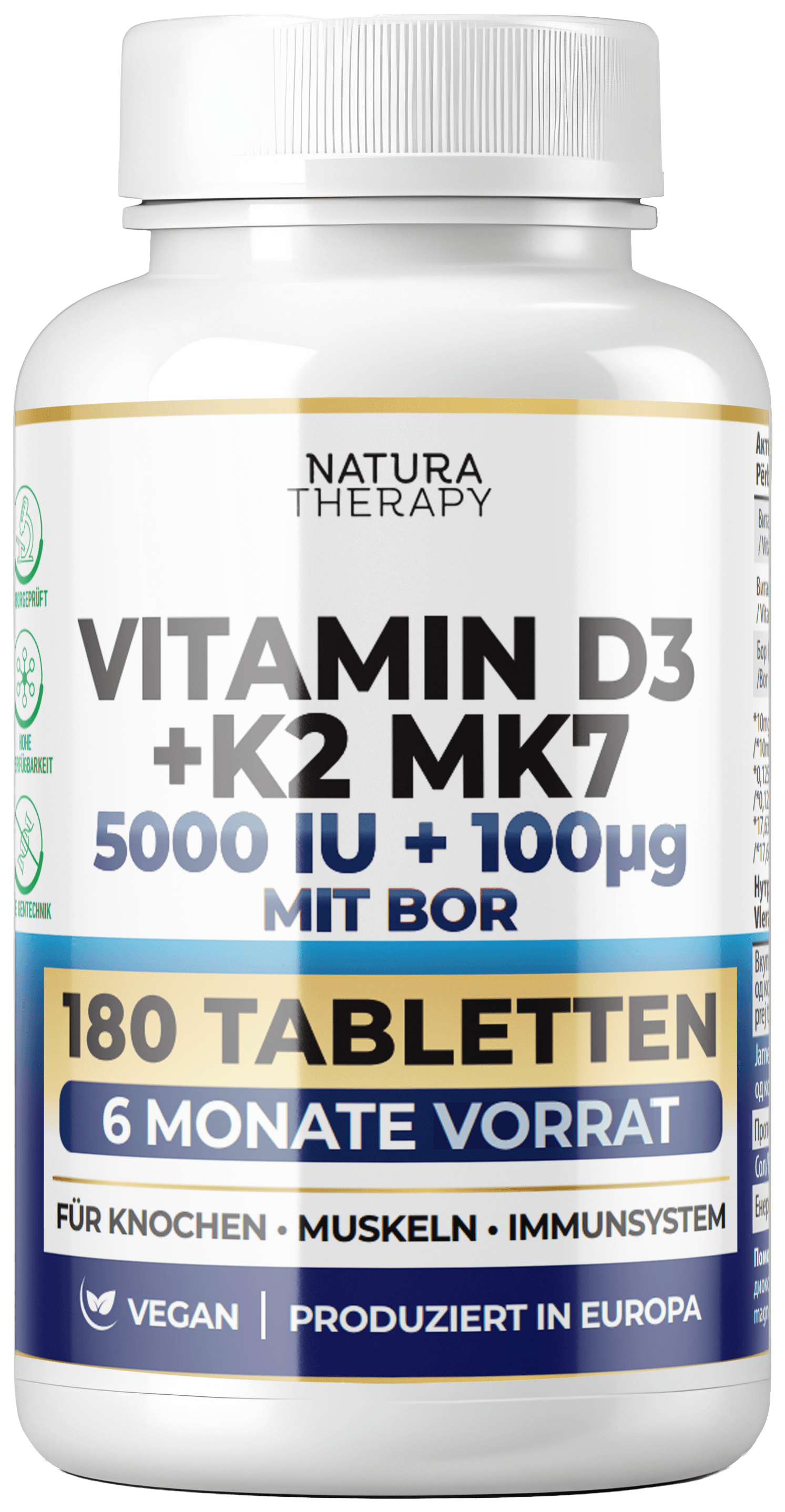
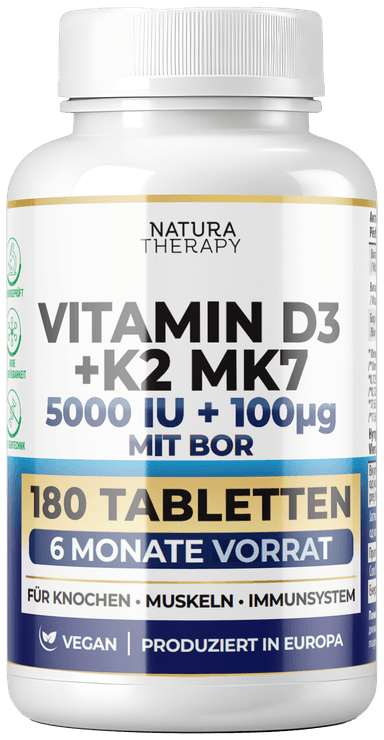
Quick answer. D3 + K2 + Bor is one tablet with 5,000 IU of vitamin D3, 100 µg of vitamin K2 (MK-7) and 2 mg of boron. Vitamin D contributes to the normal absorption of calcium, and vitamin K to the maintenance of normal bones, so the two make the most sense together when D3 is taken for months. Take one tablet a day with a meal that contains a little fat. It is a stronger dose, so don’t take any other vitamin D alongside it, and if you take blood-thinning medicines, take it only as agreed with your doctor.

“D3 K2,” “vitamin D3 K2,” “d3 k2 bor”: we see this question here more and more often. Behind it is the same thing: why exactly these three together, whether it is better than plain D3, and who it is for. In this guide we answer directly, with sources, and we also tell you what the studies did not show.

If you only want to know how many IU of vitamin D3 a day and when to take it, that’s in the vitamin D3 guide. Here we go deeper into the combination.
01In brief

D3 + K2 + boron at a glance

One tablet, three ingredients, one habit with a meal.

5,000 IUvitamin D3125 µg in one tablet, a stronger dose
100 µgvitamin K2 (MK-7)the form that stays in the blood longer
2 mgborona trace element, far below the upper limit
180tabletsone a day, about six months
  • One tablet a day, with a meal
  • Vegan formula
  • Made in the EU
Why this formula

Three ingredients, one habit

  • D3, K2 (MK-7) and boron in one tablet
  • one tablet a day, with a meal
  • 180 tablets, about six months
  • vegan formula, made in the EU

View D3 + K2 + Bor

If you take vitamin D3 for months and your bones matter to you, there is no need to buy three separate bottles. One tablet holds all three ingredients, in amounts you can read directly on the label. Below we explain what each of them does, what is proven and what is not, and how to take it safely.

02D3 and K2

Why D3 alone isn’t the whole story

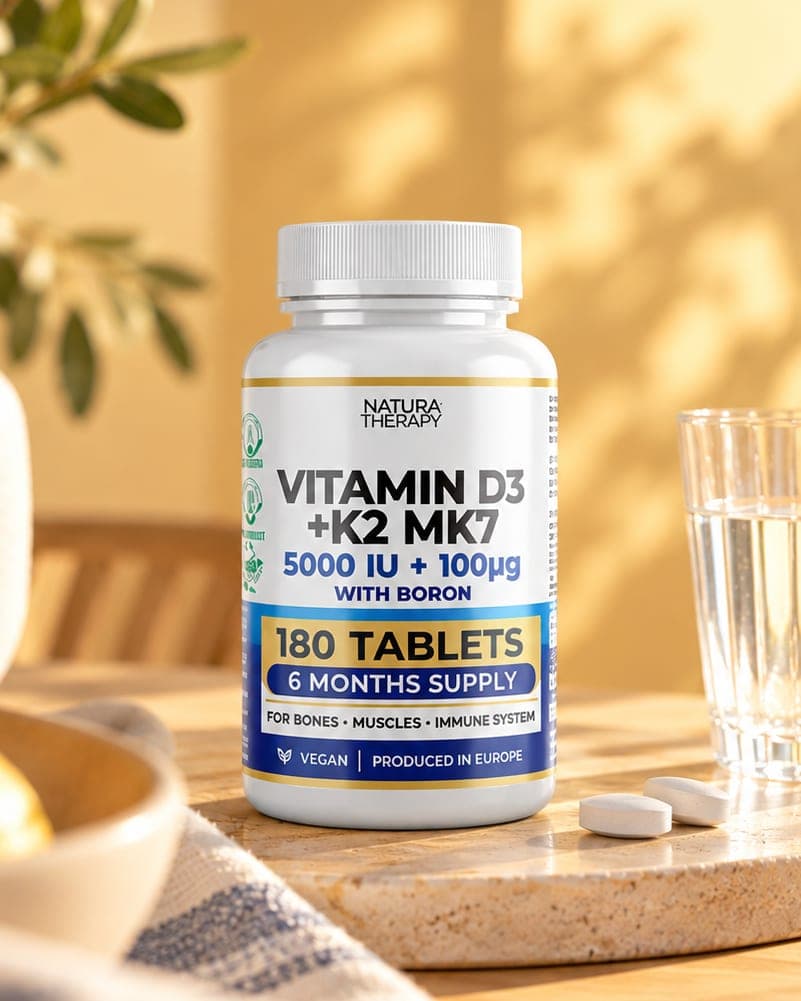
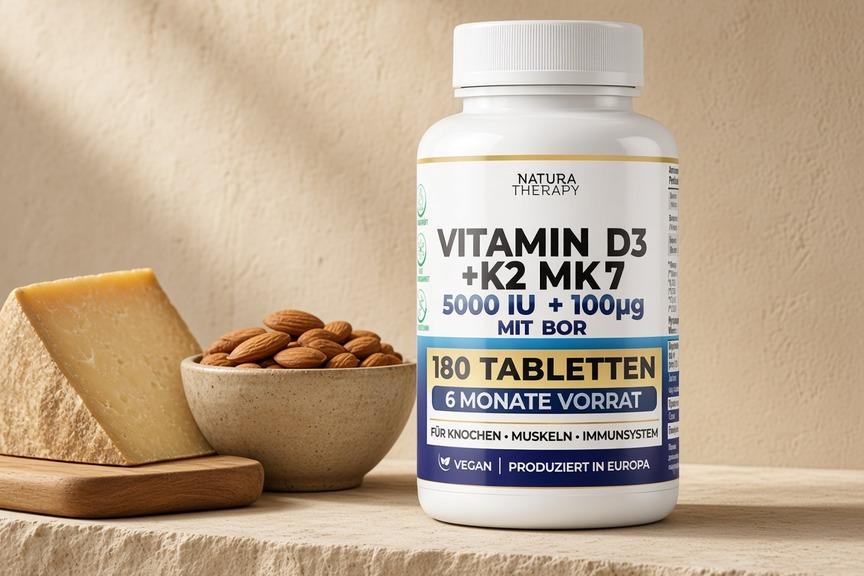
A D3 + K2 + Bor pack on a stone table next to cheese and almonds

Vitamin D and vitamin K have different authorized claims, and they overlap when it comes to bones. Vitamin D contributes to the normal absorption and utilization of calcium, and both vitamins contribute to the maintenance of normal bones.

D3normal absorption of calciumK2 (MK-7)maintenance of normal bones
  • Vitamin D contributes to the normal absorption and utilization of calcium and phosphorus and to a normal level of calcium in the blood.
  • Vitamin K contributes to the maintenance of normal bones and to normal blood clotting.

EU-approved claims for both vitamins

Bones
vitamins D and K contribute to the maintenance of normal bones
Calcium
vitamin D contributes to the normal absorption and utilization of calcium and phosphorus
Muscles
vitamin D contributes to the maintenance of normal muscle function
Immunity
vitamin D contributes to the normal function of the immune system
Clotting
vitamin K contributes to normal blood clotting
Teeth
vitamin D contributes to the maintenance of normal teeth
  • The logic of the combination: both vitamin D and vitamin K contribute to the maintenance of normal bones. That is why D3 and K2 are most often taken together when D3 is taken for a longer time.
03MK-7

K2 as MK-7: why this particular form

Vitamin K has several forms. The difference between them matters for how long it stays in the body.

K1 from vegetables

In spinach, cabbage, broccoli and lettuce. It is used up quickly, so the level in the blood drops quickly.

K2 from fermented foods

In some hard cheeses and fermented dairy products, and most of all in natto, which is rarely eaten here.

MK-7 in the tablet

The form of K2 in D3 + K2 + Bor. In studies it stays in the blood longer than K1 and gives a more stable level, so one dose a day is enough.

What the MK-7 study showed

In a study with healthy volunteers, MK-7 and K1 were absorbed well, but MK-7 had a much longer half-life. With daily intake the level in the blood was more stable, and with longer intake MK-7 reached a higher level in the blood.

100 µg K2 in the tablet

what the number means
FormMK-7
Amount per tablet100 µg
How many times a dayonce
With whata meal with some fat
  • Important: precisely because MK-7 stays in the blood for a long time, special care is needed if you take blood-thinning medicines. Details in the section on medicines.
04Boron

Boron: what it is and how much we really know

Boron is a trace element that we naturally take in with plant-based foods: fruit, nuts, legumes and vegetables. D3 + K2 + Bor has 2 mg of it per tablet.

We are being honest here, because a lot is written about boron on the internet. Here is what is certain and what is not:

Boron: how much is 2 mg

mg a day, for adults
One D3 + K2 + Bor tablet2 mg
Upper limit (EFSA), from all sources10 mg
02.557.510 mg
Known

A safe amount

EFSA sets the upper limit for adults at 10 mg of boron a day. The tablet has 2 mg, five times less.
Being studied

Part of the diet

We take in boron every day with food. Its role in the body is still being researched and for now there are no clear conclusions.
Not proven

No approved claim

EFSA concluded that a link between boron and the maintenance of normal bones has not been proven. That is why we promise nothing for boron.
  • What this means for you: the main work in the tablet is done by vitamins D3 and K2, which have authorized claims. Boron is an additional trace element in a small, safe amount.
05Comparison

D3 alone or D3 + K2 + boron: a comparison

Both products are good, but for different needs.

D3

Contributes to the normal absorption of calcium, to the maintenance of normal bones and muscle function and to the normal function of the immune system.

K2 (MK-7)

Contributes to the maintenance of normal bones, as a partner to D3 when taken over a longer period.

Boron

A trace element from food, in a small amount. No promises.

A comparison of our two products

Vitamin D3D3 + K2 + Bor
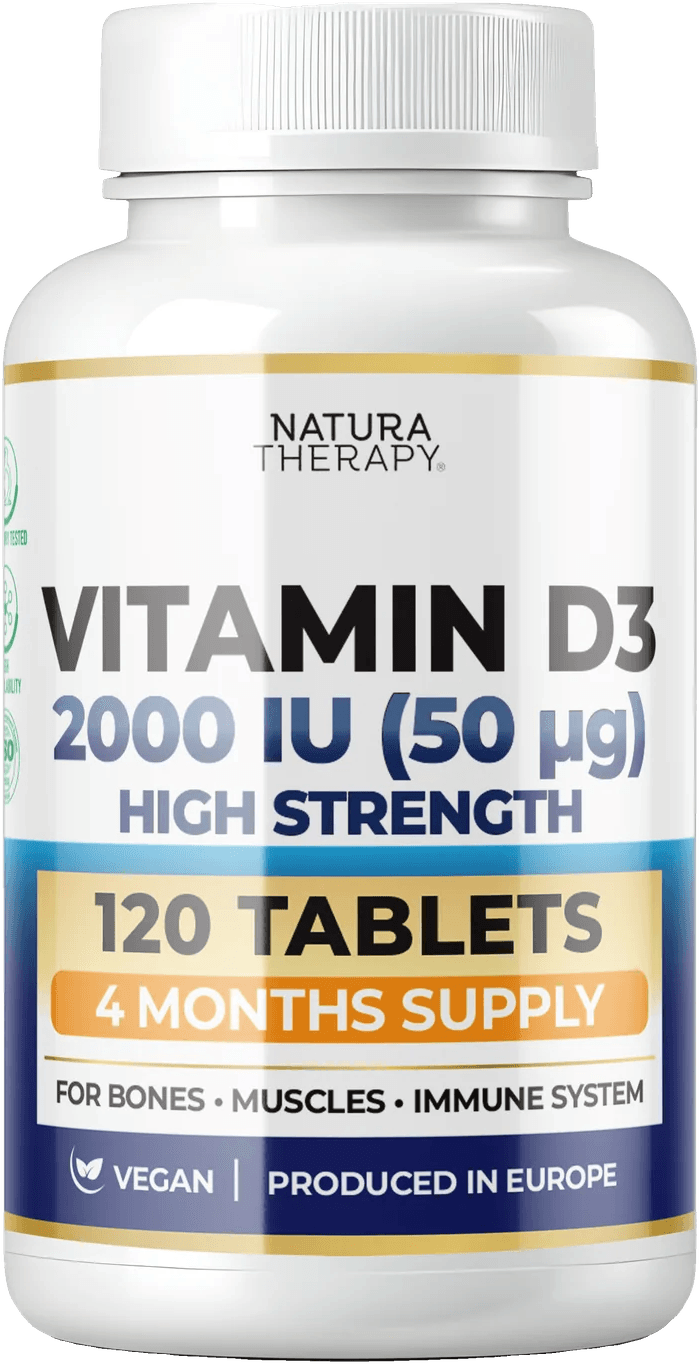
D3 per tablet2,000 IU (50 µg)5,000 IU (125 µg)
K2 (MK-7)none100 µg
Boronnone2 mg
Approved claimsvitamin Dvitamin D and vitamin K, including for the maintenance of normal bones
Pack size120 or 365 tablets180 tablets
A better fit whenyou want a classic winter routine with a usual doseyou need a stronger dose and your bones matter to you

D3 alone is enough when

  • you only need a usual dose of 1,000 to 2,000 IU in winter
  • you regularly eat cheeses, fermented dairy products and green leafy vegetables
  • you already take a multivitamin or calcium with vitamin K
  • you take warfarin or acenocoumarol: then take K2 only if your doctor agrees

D3 + K2 + boron makes more sense when

  • a test showed a low level or your doctor recommended a stronger dose
  • your bones matter to you: menopause, older age, little physical activity
  • you take D3 for months, from fall to spring
  • you want one tablet instead of three separate products

View D3 + K2 + Bor

06Who it’s for

Who D3 + K2 + boron is for

The combination makes the most sense in these situations.

  1. 01Bones

    Women during and after menopause

    Why: Vitamins D and K contribute to the maintenance of normal bones, in one tablet.Important: If you are on therapy for your bones, tell your doctor.
  2. 02Older age

    Older people and little sun

    Why: With age the skin makes less vitamin D, and in winter the sun here is weak.Important: No other product with vitamin D alongside it.
  3. 03Low level

    A test showed a low level

    Why: The stronger dose of 5,000 IU is for when your doctor has recommended more vitamin D after a test.Important: A follow-up test after 8 to 12 weeks.
  4. D3 + K2 + Bor
    04Simplicity

    One tablet instead of three bottles

    Why: D3, K2 and boron together, with one meal, no math required.Important: One tablet a day is enough.

Talk to a doctor first if

  • you take blood-thinning medicines, especially warfarin or acenocoumarol (Sintrom)
  • you have kidney stones, kidney disease, sarcoidosis or hyperparathyroidism
  • you take thiazide diuretics or digoxin
  • you are pregnant or breastfeeding
  • you already take another product with vitamin D, for example a multivitamin, drops or liquid vitamin C with D3
07Dose

5,000 IU: a stronger dose with clear rules

1,000 to 2,000 IUusual dose in winterfor most people, when they just want a baseline
4,000 IUupper limit (EFSA)for daily intake from all sources combined
5,000 IUone tablet of D3 + K2 + Bora stronger dose, for a clear need

We’ll be direct: 5,000 IU is a stronger dose. It is above the usual winter doses and above the upper limit of 4,000 IU that EFSA sets for long-term daily intake without supervision.

That is why D3 + K2 + Bor is for people who really need a stronger dose: when a test has shown a low level or when your doctor has recommended more. If you just want a classic winter baseline, the milder choice is Vitamin D3 at 2,000 IU. How many IU suit whom is covered in detail in the vitamin D3 guide.

How much D3 in one tablet

IU, relative to the upper limit
Vitamin D3, 1 tablet2,000 IU
Upper limit (EFSA)4,000 IU
D3 + K2 + Bor, 1 tablet5,000 IU

Three rules for the stronger dose

  • One tablet a day, no more.
  • No other product with vitamin D on the same day: multivitamins, drops, liquid vitamin C with D3.
  • If you take it for a longer time, arrange a 25(OH)D test with your doctor after 8 to 12 weeks.
08How to take it

How to take D3 + K2 + boron

A D3 + K2 + Bor pack on a table next to a glass of water
1

With a meal that contains some fat

D3 and K2 are fat-soluble. A breakfast with eggs, cheese or yogurt, or a lunch with olive oil, is the right choice.
A white tablet on a palm next to a glass of water
2

Every day at about the same time

There is no proven best time. Regularity is what matters, so tie the tablet to the meal you always eat.
A D3 + K2 + Bor pack next to a glass of water
3

One tablet, no other D

The tablet already provides a stronger dose. Don’t add another product with vitamin D on the same day.
4

Fine with magnesium

Magnesium and D3 + K2 + Bor can be taken on the same day, for example D3 + K2 + Bor with breakfast and magnesium in the evening. Which magnesium is for what is explained in the magnesium guide.

Morning or evening

Both are fine. Choose the meal you eat most regularly.

No need for separate calcium

Most people who eat dairy products don’t need a separate calcium supplement.

If you forget

Continue the next day with one tablet. Don’t take two to make up for it.
  • Tip: put the pack next to your coffee cup or the salt shaker on the table. With vitamin D what matters is regularity over months, not a single tablet.
09Winter plan

One winter, one pack

Vitamin D is a habit for the whole winter, not for one day. This is the realistic framework for 180 tablets:

October
The first tablet with breakfast. The sun is already low and the skin makes less and less vitamin D.
The first weeks
The level rises slowly. It’s important not to skip days.
After 8 to 12 weeks
If you take a stronger dose for a longer period, this is the right time for a follow-up test.
End of February
Without a supplement the level is usually at its lowest, so regularity pays off most at this time.
End of March
You are getting close to the last tablet in the pack, and the sun is starting to help again around midday.
Smiling older woman on a sunny terrace, a D3 + K2 + Bor pack on the table
180tablets per packone a day, about six months
October to Marchone winter seasonalmost exactly as long as one pack lasts
1tablet a daywith a meal, no calculating
10Safety

K2 and blood-thinning medicines

If you take warfarin or acenocoumarol (Sintrom)

These medicines work precisely through vitamin K. In a study with healthy volunteers taking acenocoumarol, MK-7 at just 10 µg a day significantly changed the INR in some of them. One tablet of D3 + K2 + Bor has 100 µg.

So: do not start or stop K2 without telling your doctor. If your doctor agrees, he or she will monitor your INR value.

10 µgMK-7 a dayalready affected the INR in some of the people taking acenocoumarol
100 µgK2 in one tabletso with these medicines, only as agreed with your doctor
INRthe value your doctor monitorswith every change in vitamin K
  • The new anticoagulants (rivaroxaban, apixaban, dabigatran) do not work through vitamin K, but even then ask your doctor before any new supplement.
  • Before surgery or at the dentist tell them which supplements you take, just as you would for medicines.
11Evidence

What the studies showed, and what they didn’t

This is why we speak modestly, not loudly.

Modest

Women after menopause

In 244 healthy women, 180 µg of MK-7 a day for three years gave a smaller loss of bone density in the spine and the femoral neck, but not in the whole hip.
No effect

One year, no difference

In 334 women early after menopause, 360 µg of MK-7 a day for one year did not change the loss of bone mass.
Insufficient

A review of 36 studies

In postmenopausal women and people with osteoporosis there is no evidence that vitamin K changes bone density or spinal fractures. There may be fewer other fractures, but the evidence is not sufficient.
No effect

More D3 doesn’t mean stronger bones

In healthy people without a deficiency, 4,000 and 10,000 IU of D3 a day for three years did not give stronger bones than 400 IU. That is why the stronger dose is for a clear need, not just in case.
Not proven

Boron and bones

EFSA concluded that a link between boron and the maintenance of normal bones has not been proven.
Not proven

“K2 clears calcium out of the blood vessels”

There is no reliable clinical evidence for this in humans, and we don’t claim it.
  • Conclusion: D3 + K2 is a logical combination when D3 is taken for months and when your bones matter to you. Vitamins D and K contribute to the maintenance of normal bones. That is the real benefit, without bigger promises.
  • Important: food supplements are not medicines. If you have a bone diagnosis, D3 + K2 + Bor does not replace the therapy your doctor has given you.
12Choice

Where to find it

One tablet a day, with a meal, from fall to spring.

Why this formula

Three ingredients, one habit

  • D3, K2 (MK-7) and boron in one tablet
  • one tablet a day, with a meal
  • 180 tablets, about six months
  • vegan formula, made in the EU

View D3 + K2 + Bor

Quick pick

Two important rules

  • Alongside D3 + K2 + Bor, don’t take another product with vitamin D.
  • If you take blood-thinning medicines, ask your doctor first because of the K2.

You can always see the current price on the product page.

13Questions

Common questions about D3 + K2 + boron

What is D3 K2 and why are they taken together?+

D3 and K2 are two fat-soluble vitamins. Vitamin D contributes to the normal absorption of calcium, and vitamin K to the maintenance of normal bones. That is why they are combined when D3 is taken for a longer time and when your bones matter to you.

What is in one tablet of D3 + K2 + Bor?+

5,000 IU (125 µg) of vitamin D3, 100 µg of vitamin K2 in the MK-7 form and 2 mg of boron. The pack has 180 tablets.

When should you take D3 + K2 + boron, in the morning or in the evening?+

There is no proven best time. Take the tablet every day at about the same time, with breakfast or lunch.

Is D3 K2 taken with food?+

Yes, with a meal that contains a little fat, for example eggs, cheese, yogurt or olive oil. Both vitamins are fat-soluble and are absorbed better that way.

What is MK-7?+

MK-7 is a form of vitamin K2. In studies it stays in the blood longer than the K1 from vegetables, so the level is more stable and one dose a day is enough.

Why is there boron in the formula?+

Boron is a trace element that we naturally take in with fruit, nuts and vegetables. The tablet has 2 mg, and the upper limit for adults is 10 mg a day. There is no authorized health claim for boron, so we do not promise any particular effect.

Is 5,000 IU a lot?+

It is a stronger dose, above the usual 1,000 to 2,000 IU and above the upper limit of 4,000 IU that EFSA sets for long-term daily intake. It is intended for when you need a stronger dose, for example when a test has shown a low level. Do not combine it with another vitamin D, and if you take it for a longer time, arrange a test with your doctor.

Can D3 K2 be taken with blood-thinning medicines?+

If you take warfarin or acenocoumarol (Sintrom), take K2 only as agreed with your doctor, because vitamin K changes the effect of these medicines. Ask your doctor before any new supplement, even if you take one of the new anticoagulants.

Can D3 + K2 + boron be taken with magnesium?+

Yes, they can be taken on the same day, with no need to space them apart. Magnesium contributes to the maintenance of normal bones and normal muscle function.

How long does one pack last?+

180 tablets at one tablet a day last 180 days, about six months, almost exactly from October to the end of March.

Can I take it all year?+

If you are often out in the sun in summer, it is usually not necessary. If you take the stronger dose for several months in a row, arrange a 25(OH)D test with your doctor to find out whether you need the same dose.

Does D3 K2 clear calcium from the blood vessels?+

That has not been proven by reliable clinical studies in humans and we do not promise it. The authorized claim in the EU is that vitamins D and K contribute to the maintenance of normal bones.

Do I need a test before I start?+

For usual doses, usually not. For the stronger dose of 5,000 IU, especially if you take it for a longer time, it is useful to know what your level is, so talk to your doctor about a 25(OH)D test.

This text is for information only and is not a substitute for advice from a doctor or pharmacist. Food supplements are not medicines and are not a substitute for a varied and balanced diet and a healthy lifestyle. Do not exceed the recommended daily dose. Keep out of reach of children.

Sources 11
  1. Regulation (EU) No 432/2012 on the list of permitted health claims made on foods (vitamin D and vitamin K)
  2. EFSA NDA Panel, „Scientific Opinion on the substantiation of health claims related to vitamin K and maintenance of bone (ID 123, 127, 128, and 2879), blood coagulation (ID 124 and 126), and function of the heart and blood vessels (ID 124, 125 and 2880)“, EFSA Journal, 2009;7(10):1228 (doi:10.2903/j.efsa.2009.1228)
  3. EFSA NDA Panel, „Scientific Opinion on the substantiation of health claims related to boron and maintenance of bone (ID 218, 219) and maintenance of joints (ID 219, 220)“, EFSA Journal, 2009;7(10):1261 (doi:10.2903/j.efsa.2009.1261)
  4. EFSA NDA Panel, „Opinion related to the Tolerable Upper Intake Level of Boron (Sodium Borate and Boric Acid)“, EFSA Journal, 2004;2(8):80 (doi:10.2903/j.efsa.2004.80)
  5. EFSA NDA Panel, „Scientific opinion on the tolerable upper intake level for vitamin D, including the derivation of a conversion factor for calcidiol monohydrate“, EFSA Journal, 2023;21(8):8145 (doi:10.2903/j.efsa.2023.8145)
  6. Schurgers L.J. et al., Blood, 2007;109(8):3279-3283 (PMID 17158229)
  7. Knapen M.H. et al., Osteoporos Int, 2013;24(9):2499-2507 (PMID 23525894)
  8. Emaus N. et al., Osteoporos Int, 2010;21(10):1731-1740 (PMID 19937427)
  9. Mott A. et al., Osteoporos Int, 2019;30(8):1543-1559 (PMID 31076817)
  10. Theuwissen E. et al., J Thromb Haemost, 2013;11(6):1085-1092 (PMID 23530987)
  11. Burt L.A. et al., JAMA, 2019;322(8):736-745 (PMID 31454046)
RECOMMENDED FOR THIS TOPIC

Related products

We use cookies to analyze traffic and improve your experience. See our privacy policy.